
Spousal Support Lawyers Helping Clients Navigate The California Spousal Support Process

Orange County Spousal Support Lawyers Helping Clients Pursue Substantial Awards
When a marriage ends in California, financial support between former spouses can become one of the most contested aspects of the divorce process. Whether you are seeking spousal support after years of building a life together or facing a request for ongoing payments, the decisions made during this process will have lasting financial consequences for both parties.
At Sarieh Family Law, our Orange County spousal support attorneys bring over 20 years of family law experience to every case we handle. Founded by attorney Wail Sarieh, our firm has guided countless clients through the complexities of California spousal support law, helping both recipients and payors achieve fair, legally sound outcomes.
We understand that financial concerns are deeply personal. Spousal support proceedings are not simply about numbers on a spreadsheet; they reflect years of shared sacrifice, career decisions made for the benefit of the family, and the real-world challenges of rebuilding financial independence after a long-term relationship ends. Our approach is rooted in compassion and a genuine commitment to your long-term well-being.
Whether you need guidance on temporary support during divorce proceedings, help challenging an existing order, or representation in a modification hearing, our team is ready to help. We serve clients across Orange County, including Costa Mesa.

What Clients are saying
What Is Spousal Support in California?
Spousal support, also called alimony or spousal maintenance, is court-ordered financial assistance paid by one spouse to the other following a separation or divorce. The terms are interchangeable under California law, and courts may award it as either a temporary arrangement during divorce proceedings or as a longer-term obligation following the finalization of a dissolution.
The purpose of spousal support is not punitive. California courts do not award it as a reward or penalty. Instead, support is designed to limit the unfair economic effect of divorce on a lower-earning spouse and to help that spouse maintain a standard of living reasonably comparable to what the couple shared during the marriage.
Orange County is one of the most expensive regions in California, and the financial stakes in spousal support cases here are significant. Whether you are seeking support after dedicating years to raising children or managing household responsibilities, or whether you are a higher-earning spouse concerned about an open-ended support obligation, the outcome of your case will shape your financial future for years to come.
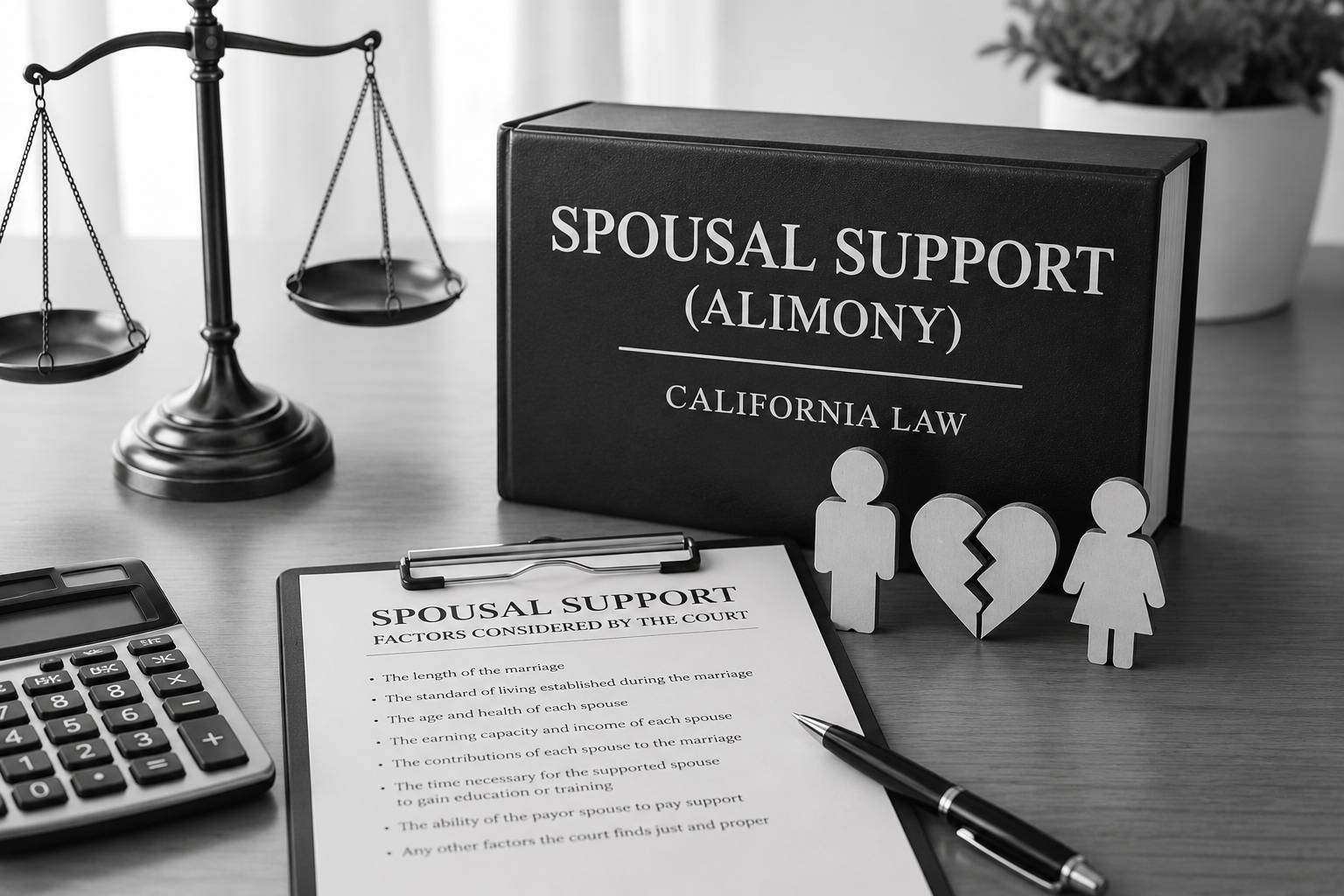
Types of Spousal Support in California
California law recognizes two primary categories of spousal support: temporary support awarded during the divorce proceedings, and permanent (long-term) support ordered as part of the final divorce judgment.
Temporary Spousal Support (Pendente Lite Support)
Temporary spousal support begins during the divorce proceedings, before a final judgment is entered. Under California Family Code Section 3600, either spouse may request temporary support while the case is pending. These awards are designed to maintain the financial status quo during what can be a lengthy legal process.
Courts calculate temporary support using a formula based largely on each party’s income and tax filing status. The aim is to preserve the marital standard of living while the divorce is ongoing. Temporary orders end automatically when the court issues a final divorce judgment.
It is important to act promptly when seeking temporary support. Our attorneys can file an emergency motion with the Orange County Superior Court when circumstances require urgent financial relief during proceedings.
Permanent (Long-Term) Spousal Support
Despite its name, “permanent” support does not necessarily last forever. Permanent spousal support is ordered at the conclusion of the divorce case based on a detailed analysis of the factors outlined in California Family Code Section 4320. Courts retain flexibility to order support for a defined term or to leave the order open-ended depending on the circumstances of the marriage.
The distinction between temporary and permanent support matters because they are governed by different legal standards. Permanent support orders require a full analysis of the California Family Code Section 4320 factors, which we discuss in detail below, and the amount may change significantly when a case moves from temporary to permanent support.
How California Courts Determine Spousal Support
Permanent spousal support in California is governed by California Family Code Section 4320, which sets out a comprehensive list of factors courts must consider. There is no single formula for permanent support; judges exercise significant discretion in weighing these factors based on the specific circumstances of your marriage and divorce.
The California Family Code Section 4320 factors include:
| Factor | Description |
|---|---|
| Earning Capacity | Each party’s ability to maintain the marital standard of living based on earning capacity, marketable skills, and job market conditions |
| Education and Career Contributions | Whether the supported spouse contributed to the other party’s education, training, career position, or professional license |
| Ability to Pay | The supporting party’s current income, assets, and overall financial capacity to pay support |
| Needs Based on Marital Standard | The financial needs of each party are based on the standard of living established during the marriage |
| Obligations and Assets | Each party’s existing debts, property, and financial obligations at the time of the hearing |
| Duration of Marriage | The length of the marriage is a key factor in both the amount and duration of support awarded |
| Dependent Children | Whether the supported party’s employment would unduly interfere with caring for dependent children in their custody |
| Age and Health | The physical and mental condition of both parties and any limitations on earning capacity |
| Domestic Violence History | Documented evidence of any history of domestic violence in the relationship |
| Tax Consequences | The immediate and specific tax impact on each party under current federal and state law |
| Balance of Hardships | The relative financial hardship that support would create or relieve for each party |
| Goal of Self-Sufficiency | The supported party’s ability to become self-supporting within a reasonable period of time |
Courts may also consider any other factors they find just and equitable under the circumstances. Because this is a highly discretionary analysis, the quality of your legal representation can make a meaningful difference in the outcome of your case. Our attorneys work with financial experts and vocational counselors when necessary to build the most complete and compelling picture of your circumstances for the court.
- Catching the Warning Signs of Marital Strife Knowing the warning signs of marital strife is key to having a healthy relationship with your spouse. These signs—communication breakdown, no emotional connection, constant criticism—can all mean deeper issues in the marriage. Addressing these signs early can stop the decline and build a more supportive partnership. Another big warning sign is living separate lives, emotional disconnection, and isolation. This can damage the bond between spouses and children, so we need… Read More
- The Social Media Evidence Trap in a Divorce Every day, millions of people share details on social media. In Orange County divorce proceedings, those moments become evidence that can significantly impact your case. According to the American Academy of Matrimonial Lawyers, over 80 percent of divorce attorneys have reported increased use of social media as evidence in divorce cases. A photograph showing you enjoying luxury vacations while claiming financial hardship creates a contradiction that judges notice. Screenshots and… Read More

How Long Does Spousal Support Last in California?
The duration of spousal support depends significantly on the length of your marriage and the specific circumstances of both parties. California law treats short-term and long-term marriages differently.
Marriages Under 10 Years
For marriages lasting less than 10 years, California courts generally apply a guideline that spousal support should last for approximately half the length of the marriage. This principle is reflected in California Family Code Section 4320(l), which sets the goal that a supported party become self-sufficient within a “reasonable period of time.”
This is a guideline, not an absolute rule. Courts retain discretion to order a shorter or longer support period based on the full range of Section 4320 factors. For example, if a supported spouse has a serious medical condition that limits employment options, a court may extend support beyond the standard guideline even for a shorter marriage.
Marriages Over 10 Years (Long-Term Marriages)
California Family Code Section 4336 provides that for marriages lasting 10 years or more, the court retains jurisdiction over spousal support indefinitely. This means there is no automatic cutoff date, and the court can revisit, modify, or terminate support as circumstances change throughout the parties’ lives.
In practice, support in long-term marriages may continue for many years, particularly where one spouse significantly reduced their career to raise children or support the family. Courts take the sacrifices made during the marriage seriously and are generally more willing to award extended support in longer marriages.
The Gavron Warning
Courts often issue what is known as a “Gavron Warning” to the supported spouse. Named after the California appellate case In re Marriage of Gavron, this warning formally notifies the recipient that they have a legal obligation to make good-faith efforts to become self-supporting. Failure to do so can be cited as grounds for modification or termination of support in future proceedings.
If you have received a Gavron Warning, it is important to document your efforts to gain or improve employment. Our attorneys can help you understand your obligations and protect your interests if a modification is filed against you based on an alleged failure to become self-sufficient.
When Does Spousal Support Automatically Terminate?
Under California Family Code Section 4337, spousal support terminates automatically upon the death of either party or the remarriage of the supported spouse. Courts cannot order continued support after remarriage.
Cohabitation with a new partner does not automatically terminate support, but it creates what California law calls a “rebuttable presumption” of decreased financial need. Under California Family Code Section 4323, when a supported spouse cohabitates with another person, there is a presumption that their need for support has been reduced. The supporting spouse may use this as grounds to file for modification or termination of support.
Modifying a Spousal Support Order in California
Spousal support orders are not permanent in a rigid sense; California courts retain jurisdiction to modify support when there has been a material change in circumstances since the original order was issued. Either spouse can request a modification, whether they are the payer or the recipient.
-
What Qualifies as a Material Change in Circumstances?
Common grounds for requesting a modification include:
- A significant increase or decrease in either spouse’s income or employment status
- Job loss or an involuntary reduction in hours or earnings
- A new medical condition affecting the payer’s or recipient’s earning capacity
- Retirement of the paying spouse at an appropriate age
- The supported spouse is beginning to cohabitate with a new partner
- Completion of an educational program that substantially increases the recipient’s earning capacity
- A substantial change in the financial needs of the supported party
-
How to Request a Modification
To modify a spousal support order, the requesting party must file a Request for Order with the Orange County Superior Court and demonstrate that a material change in circumstances has occurred since the original order. The court will then schedule a hearing where both parties can present evidence and arguments.
If you are the paying spouse and your financial situation has changed significantly, we can help you file for a modification before past-due support amounts accumulate. If you are the recipient and believe your former spouse’s financial situation has improved substantially, we can help you pursue an increase. Acting promptly is important: courts typically will not retroactively modify payments to a date before the motion was filed.
-
Permanent Domestic Violence Restraining Order
Despite its name, a permanent DVRO is not necessarily forever. After the TRO hearing, both parties have the opportunity to present evidence and testimony. If the judge finds sufficient evidence of abuse, a permanent DVRO can be issued for a period of up to five years, with the option to renew.
Vocational Evaluations in Orange County Spousal Support Cases
When there is a dispute about a supported spouse’s ability to work and become self-supporting, California courts may order a vocational evaluation. Under California Family Code Section 4331, a vocational training counselor may be appointed to assess the supported spouse’s employment skills, current job market conditions, and the education or training needed to re-enter the workforce.
A vocational evaluation typically examines:
- The supported spouse’s work history and educational background
- Current job market conditions for their field in Orange County and the broader Southern California region
- Any physical, mental, or age-related limitations on their ability to work full-time
- The time and estimated cost of any retraining or education required to reach gainful employment
- A realistic assessment of the income potential that the supported spouse can expect to achieve
Vocational evaluations can be requested by either party. If you are the supporting spouse, an evaluation may demonstrate that your former spouse has the genuine capacity to work and support themselves, which can reduce or eliminate the support obligation. If you are the supported spouse, you can challenge an evaluation that fails to account for real-world employment barriers, gaps in your work history, or the actual state of the job market in your field.
Our attorneys have experience working with vocational experts in Orange County family law proceedings and can help you prepare for or respond to a vocational evaluation effectively.
How Domestic Violence Affects Spousal Support in California
California law takes documented domestic violence seriously in spousal support proceedings. The California Family Code includes specific provisions that address how a history of domestic violence must influence support determinations.
Under California Family Code Section 4320(i), courts must consider documented evidence of domestic violence between the parties as one of the mandatory factors in the Section 4320 analysis. Section 4320(n) also requires consideration of a criminal conviction for domestic violence against the other spouse.
California Family Code Section 4325 goes further, creating a presumption against awarding spousal support to a party who has been convicted of a domestic violence offense against the other spouse within five years preceding the divorce filing. This presumption can be rebutted, but it significantly shifts the burden in cases where there is a documented criminal conviction.
If you have experienced domestic violence in your marriage, proper documentation is critical. Police reports, restraining orders, medical records, and other evidence can all be relevant in your support proceedings. Our attorneys approach these sensitive matters with both legal precision and genuine compassion for our clients.
Tax Implications of Spousal Support in California (2024 and Beyond)
The tax treatment of spousal support changed significantly under the Tax Cuts and Jobs Act of 2017. The new rules apply to divorce and separation agreements executed after December 31, 2018, and have important implications for both paying and receiving spouses.
For divorces finalized after December 31, 2018:
- The paying spouse cannot deduct spousal support payments from their federal taxable income
- The receiving spouse does not report spousal support payments as taxable income
This reversed the rules that applied to divorces finalized before January 1, 2019. Under the prior rules, payments were deductible to the payer and constituted taxable income to the recipient. If your divorce was finalized before that date, the original tax treatment generally continues to apply unless the agreement is later modified and explicitly states that the new rules apply.
These tax differences have a real impact on negotiations. Because the paying spouse no longer receives a federal deduction, the true after-tax cost of spousal support has increased substantially. Both parties should fully understand the tax consequences when negotiating or litigating support amounts. Our firm works alongside experienced financial professionals to help clients make fully informed decisions.
Why Choose Sarieh Family Law for Your Spousal Support Case?
At Sarieh Family Law, we bring more than 20 years of California family law experience to every spousal support matter. Attorney Wail Sarieh founded this firm with a commitment to community involvement, education, and client empowerment. We believe every client deserves to fully understand not only the legal strategy we recommend but the reasoning behind it.
Our Orange County spousal support attorneys assist clients with:
- Calculating and negotiating temporary support during divorce proceedings
- Building the strongest possible case for permanent support at trial or settlement
- Enforcing existing support orders when a former spouse has stopped paying
- Filing for modification when financial circumstances have changed significantly
- Defending against improper modification or termination requests
- Navigating Gavron Warning obligations and self-sufficiency compliance
- Coordinating with vocational evaluators and financial experts
- Addressing domestic violence history in support proceedings
We represent both support recipients and paying spouses, bringing the same level of thoroughness and dedication to each side of the case. Whether your matter involves a short-term marriage or a decades-long partnership, our attorneys have the experience to guide you toward the best possible outcome.
We serve clients throughout Orange County, including Costa Mesa and surrounding communities.
Contact Our Orange County Spousal Support Attorneys Today
Spousal support proceedings require careful legal strategy and a thorough understanding of California family law. Whether you are seeking a support award or defending against one, having an experienced attorney on your side matters.
At Sarieh Family Law, we are committed to helping our clients achieve financially secure outcomes through clear, compassionate, and highly competent representation. Attorney Wail Sarieh and our team are ready to evaluate your situation, explain your options, and develop a strategy tailored to your specific circumstances.
Contact us today to schedule a consultation at one of our office in Costa Mesa or reach us by phone. Serving Orange County families for over 20 years.

Recent Case Results
-
Our client in this case was the mother of the only child of marriage. Our child custody law firm took the case that started in 2009 with the mother filing a Petition for custody and support of a child against the father where the parties reached a stipulation and order awarding the mother sole legal and sole physical custody. Later on the mother filed a divorce case and since the father failed to respond, the mother entered his default in 2010. The divorce case was consolidated with the paternity case.
In early 2012, the mother and without notifying the father moved to another State. The father filed a police report and hired a very aggressive Orange County Family Law attorney who filed an emergency motion with the court (ex parte application) and obtained custody for the father and appointed a child custody investigator.
The mother was arrested on a DUI despite the fact that her car was parked and she was not driving; the police justified the DUI charge as they found an open container in the car.
The child custody investigation report, based on the mother’s DUI conviction and the fact that she moved away without notifying the father, came to the conclusion that the mother should only have supervised visitation with the child and that father should have sole legal and sole physical custody of the minor child.
The matter was further complicated by the mother agreeing to “bifurcate” the trial on the custody and visitation issues and the trial was set for the second half of 2013.
The mother decided to retain Sarieh Family Law to help her litigate the child custody during the bifurcated trial.
Mr. Sarieh, an Orange County Certified Family Law Specialist challenged the entire proceedings from 2010 to 2013. Mr. Sarieh argued that every document filed including but not limited to the child investigation report and every court order rendered after the entry of default in 2010 is null and void.
Our firm was very proud of the results and very proud of our judicial officers. The judge agreed with Mr. Sarieh that the court has no jurisdiction since the default was entered in 2010. The trial by default was set in month and our client obtained a dissolution judgment awarding her sole legal and sole physical custody of the minor child.
-
Our client in this case was the father of two children; the parties were not married but cohabited together for over a decade. Throughout their cohabitation both parties worked hard to support their children; the parties lived in an upper-middle class life style during their cohabitation. Shortly after their separation, the mother claimed disability due to Reactive Airway Disease (RAD) she quit her job as mortgage broker, collected State Disability checks and filed Worker’s Compensation claim alleging her disability resulted from the poor air quality at her office.
Mr. Sarieh, an Orange County Certified Family Law Attorney, filed with the court a request to vocationally evaluate the mother. Unfortunately the vocational evaluation report concluded that the mother is employable but her employability depended on her health condition, which was beyond the vocational evaluator expertise.
In a trial that spanned over the period of months, Mr. Sarieh was able to successfully cross-examine Petitioner’s primary care physician who came to testify on her behalf. The physician admitted that his patient; the mother is able to work under certain conditions.
Mr. Sarieh subpoenaed all medical reports from the Worker’s Compensation case and was able to establish the mother’s ability to work. The Court agreed with Mr. Sarieh and stated that the mother has the obligation to support the children; the court imputed income to the mother and the child support was calculated according to the mother’s imputed income even though she was still not working at the time of trial.
-
Our client in this case was the husband, who with the wife’s agreement entered into a stipulated judgment awarding the family residence to the wife; neither party was represented and they entered the judgment with the assistance of a paralegal in Orange County. The parties were married for long time and have adult children from their marriage.
The untold story was despite the written judgment; the parties had verbally agreed that once the house is sold the wife will give the husband his fair share of the proceeds.
Of course, wife sold the house and refused to pay husband any monies. The husband sought the assistance of Sarieh Family Law; Orange County Divorce attorneys.
We began our investigation by examining the judgment, which stated unequivocally that wife gets the house. We were also faced with the legal hurdle that it is almost impossible to set aside a judgment in California if the judgment only dealt with property division and without fraud, duress or undue influence.
We noticed on the Resister of Action on the Court’s website that the initial submission of judgment was rejected by the court and that the judgment was returned. The judgment was re-submitted again and the court accepted it. We asked our client whether he knew anything about the rejection of the judgment and he indicated that he knew nothing about this rejection.
We asked for a copy of the entire file from the court itself and we did not rely only on what our client gave us. We set the wife’s deposition at our office.
We received the ordered copy of the court’s file on the morning of the wife’s scheduled deposition at our office. After a careful examination of the court’s file with our client, we found out the signature on our client’s Declaration re: Service of Declaration of Disclosure was not his.
We confronted the wife during her deposition about the falsified document but she denied any involvement and blamed the paralegal. She acknowledged that the document was not signed by our client.
We subpoenaed the paralegal to the court’s hearing to prove the wife’s fraud and we retained a handwriting expert to prove that our client’s signature was falsified by the wife herself and no one else.
Right before we entered the court room to try our case, the wife’s attorney approached us with a settlement offer giving our client what he was promised. Our client accepted the offer for the sake of the parties’ adult children.