
Orange County Family Lawyers Helping Clients With Prenuptial Agreements

Orange County Prenuptial Agreement Lawyers
When it comes to marital agreements such as prenuptial agreements, there is still a certain stigma. Many couples worry that even raising the subject will take the romance out of their relationship. In our experience, the opposite is usually true. Couples who talk openly about money, property, and expectations before the wedding tend to enter marriage with more clarity and confidence, not less.
The truth is that a well-drafted prenuptial agreement protects both partners. These agreements have grown steadily in popularity in recent years, not only among wealthy couples but also among business owners, professionals, people marrying later in life, and couples entering second marriages. California law gives engaged couples broad power to decide in advance how their property and finances will be handled, but it also imposes some of the strictest enforcement requirements in the country.
At Sarieh Family Law, we have helped many couples across Orange County draft, review, negotiate, and enforce prenuptial agreements. On this page, we answer the questions we hear most often and explain how California’s Uniform Premarital Agreement Act shapes what your prenup can do, what it cannot do, and what it takes to make it stand up in court.

What Clients are saying

What Is a Prenuptial Agreement in California?
A prenuptial agreement, often called a prenup or premarital agreement, is a written contract between two people who intend to marry. It sets out how property, debts, income, and certain financial rights will be treated during the marriage and in the event of divorce, legal separation, or death. Under Family Code section 1613, the agreement becomes effective when the couple marries.
California prenups are governed by the Uniform Premarital Agreement Act, codified at Family Code sections 1600 through 1617. The formal requirements sound simple: under section 1611, the agreement must be in writing and signed by both parties, and it is enforceable without any consideration beyond the marriage itself. In practice, however, the way the agreement is prepared, disclosed, and signed matters enormously. California courts closely examine the process behind a prenup, and agreements that ignore the statutory safeguards are routinely challenged.
A prenuptial agreement is different from a postnuptial agreement, which is signed after the wedding, and both are different from a marital settlement agreement negotiated during a divorce. Each is subject to different rules, which is one of the reasons timing matters so much.
- Catching the Warning Signs of Marital Strife Knowing the warning signs of marital strife is key to having a healthy relationship with your spouse. These signs—communication breakdown, no emotional connection, constant criticism—can all mean deeper issues in the marriage. Addressing these signs early can stop the decline and build a more supportive partnership. Another big warning sign is living separate lives, emotional disconnection, and isolation. This can damage the bond between spouses and children, so we need… Read More
- The Social Media Evidence Trap in a Divorce Every day, millions of people share details on social media. In Orange County divorce proceedings, those moments become evidence that can significantly impact your case. According to the American Academy of Matrimonial Lawyers, over 80 percent of divorce attorneys have reported increased use of social media as evidence in divorce cases. A photograph showing you enjoying luxury vacations while claiming financial hardship creates a contradiction that judges notice. Screenshots and… Read More

What a California Prenup Can Cover
Family Code section 1612 lists the subjects engaged couples may address in a premarital agreement. Broadly, you and your future spouse may contract about:
- The rights and obligations of each of you in any property, whenever and wherever it was acquired
- The right to buy, sell, use, transfer, exchange, lease, mortgage, or otherwise manage and control property
- How property will be handled upon separation, divorce, death, or any other event you choose
- The making of a will, trust, or other arrangement to carry out the terms of the agreement
- Ownership rights in, and disposition of, death benefits from life insurance policies
- The choice of law governing how the agreement is interpreted
- Any other matter, including personal rights and obligations, that does not violate public policy or a criminal statute
For most couples, the heart of the agreement is property characterization. A prenup can confirm that a business you built before the wedding remains your separate property, that an expected inheritance stays in your family, or that income each spouse earns during the marriage will be kept separate rather than pooled. It can also address responsibility for premarital debts, such as student loans, so that one spouse’s creditors cannot reach the other spouse’s earnings.
What a Prenuptial Agreement Cannot Do
California law places firm limits on premarital agreements, and understanding those limits is just as important as understanding what a prenup can accomplish.
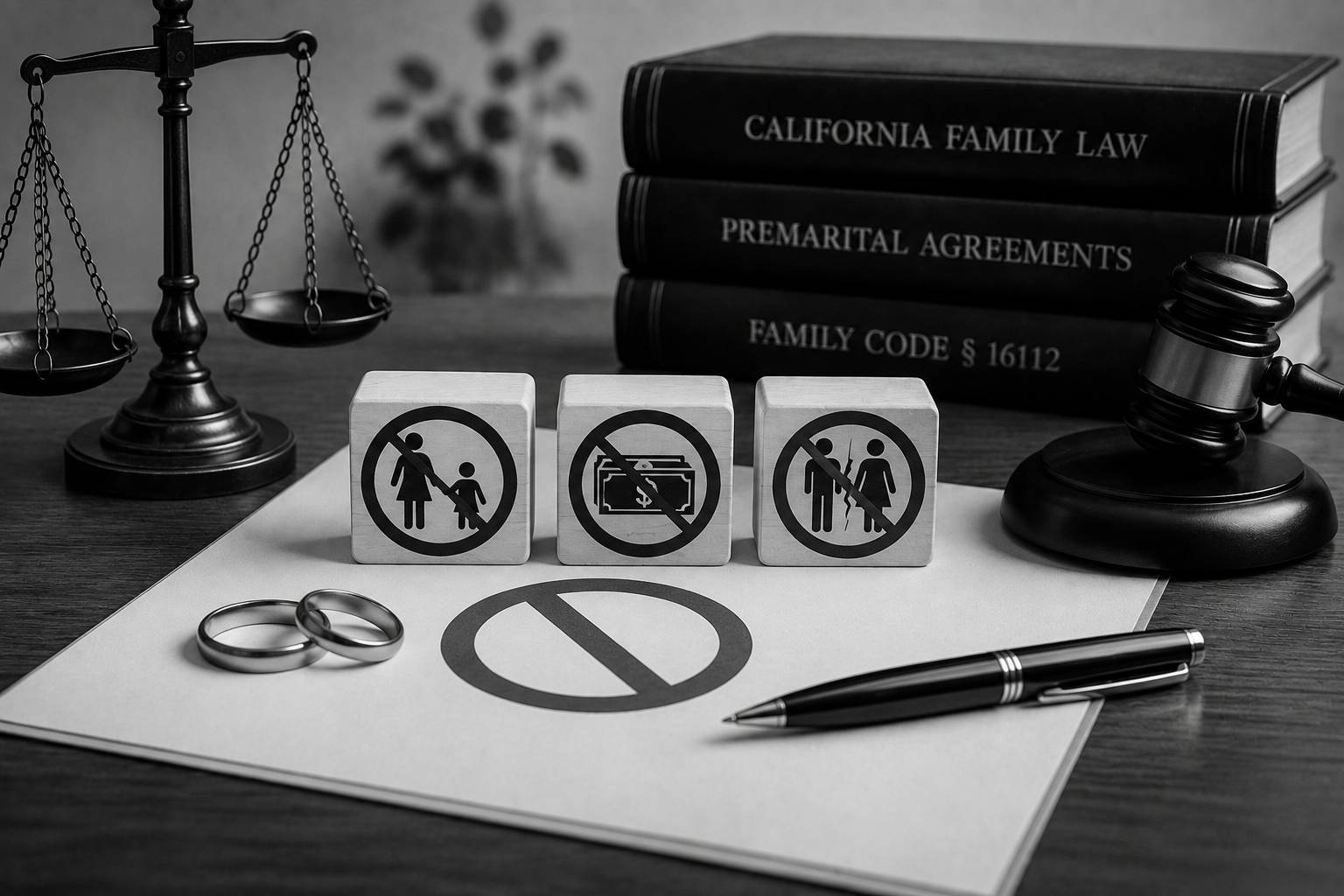
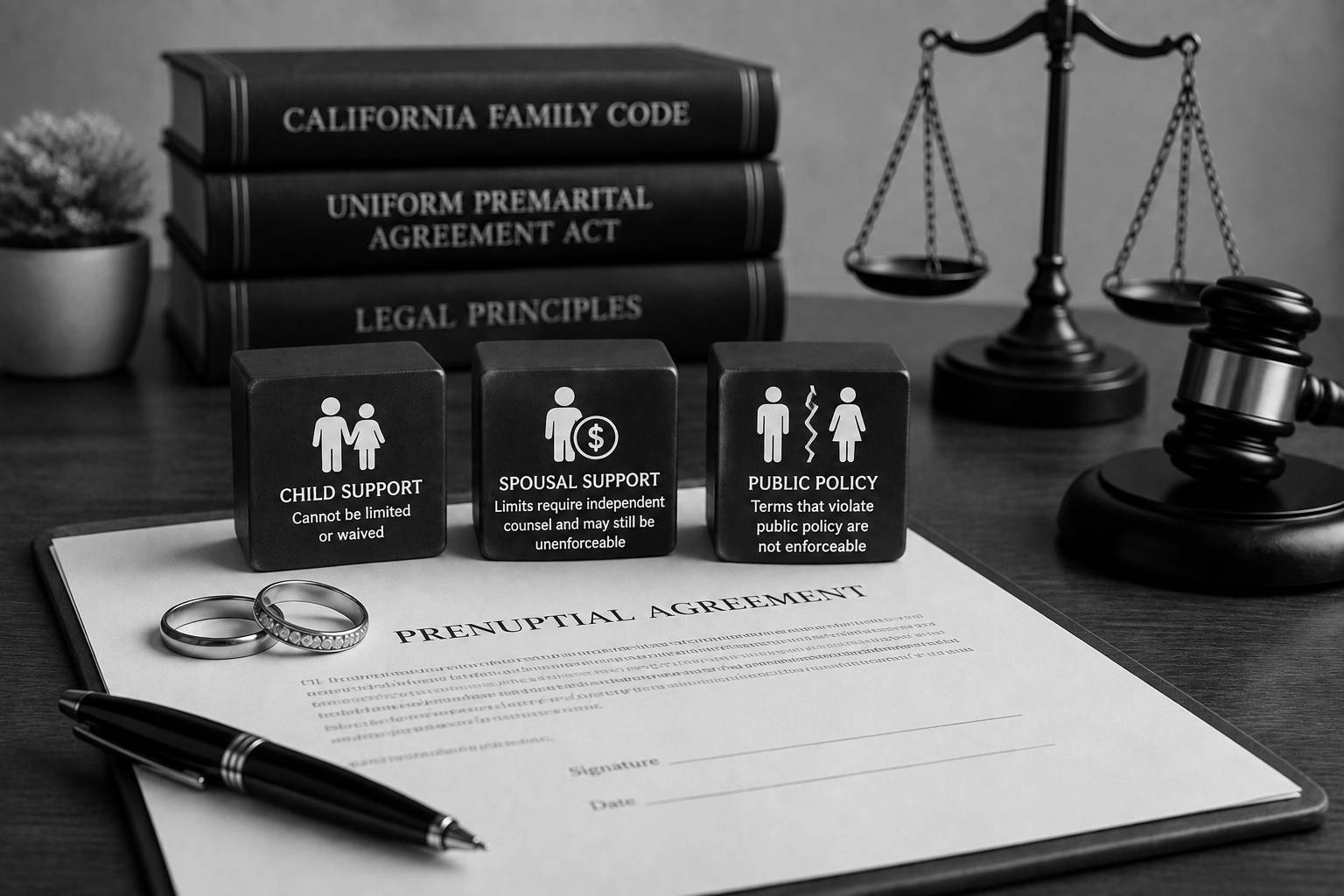
First, a prenup cannot adversely affect a child’s right to child support. Family Code section 1612 makes this explicit. Child support belongs to the child, not the parents, and courts will not enforce any provision that tries to limit it in advance. The same principle applies to child custody: decisions about where children live and how parenting time is shared are made based on the children’s best interests at the time of the dispute. They are never predetermined by contract.
Second, spousal support provisions receive special scrutiny. Under section 1612, a provision limiting or waiving spousal support is not enforceable unless the spouse giving up support rights was represented by independent counsel when the agreement was signed. Even then, a court can refuse to enforce the provision if it is unconscionable at the time of enforcement, which may be many years after the wedding. This is a deliberate policy choice: California does not want a spouse left without resources because of a waiver signed decades earlier under very different circumstances.
Finally, a prenup cannot include terms that violate public policy or a statute imposing a criminal penalty. Provisions that attempt to regulate personal conduct during the marriage, or that penalize a spouse for filing for divorce, are generally not enforceable in California.
California’s Enforcement Requirements Are Strict
California has some of the most demanding prenup enforcement rules in the nation. Family Code section 1615 provides that a premarital agreement is unenforceable if the challenging spouse proves that they did not sign it voluntarily, or that the agreement was unconscionable when signed and they did not receive fair and full financial disclosure.
The statute goes further. A court must deem the agreement involuntary, and refuse to enforce it, unless specific statutory safeguards were satisfied. The table below summarizes the key requirements for agreements signed on or after January 1, 2020:
| Requirement | What It Means in Practice |
|---|---|
| Independent counsel | Each party should be represented by their own lawyer. A party may waive representation, but only in a separate written waiver signed after being advised to seek independent counsel, with that advisement given at least seven calendar days before signing. |
| Seven day waiting period | At least seven calendar days must pass between the date a party is first presented with the final agreement and the date it is signed. For agreements signed on or after January 1, 2020, this applies even when both parties have lawyers. |
| Full financial disclosure | Each party must receive a fair, reasonable, and full disclosure of the other party’s property and financial obligations, unless further disclosure is expressly waived in writing. |
| Protections for unrepresented parties | A party who signs without a lawyer must be fully informed in writing of the terms and basic effect of the agreement and the rights being given up, in a language in which they are proficient, and must sign a declaration confirming they received and understood that explanation. |
| Voluntary execution | The court considers the circumstances of signing, including timing relative to the wedding and any evidence of duress, fraud, or undue influence, when deciding whether the agreement was truly voluntary. |
One point deserves emphasis because it is widely misunderstood: for agreements signed on or after January 1, 2020, the seven day waiting period applies regardless of whether the parties are represented by counsel. Agreements signed between 2002 and 2020 are evaluated under a different version of the rule. If you signed a prenup years ago and are unsure where it stands, we can review it and give you a candid assessment.
Unconscionability is decided by the court as a matter of law. In plain terms, a judge decides whether the agreement was so one sided when signed, without adequate disclosure, that it should not be enforced.



Community Property Rules: Why a Prenup Matters in California
To understand what a prenuptial agreement really does, it helps to understand the default rules it replaces. California is a community property state. Under Family Code section 760, property acquired by either spouse during the marriage while living in California is presumed to be community property, owned equally by both spouses. In a divorce, the court divides the community estate equally unless the spouses have agreed otherwise in writing.
| Generally Community Property | Generally Separate Property |
|---|---|
| Wages and income earned by either spouse during the marriage | Property owned by either spouse before the marriage |
| Property purchased with marital earnings, including homes and vehicles | Inheritances and gifts received by one spouse, whether before or during the marriage |
| Retirement benefits earned during the marriage | Income, rents, and profits generated by separate property |
| Business growth attributable to a spouse’s efforts during the marriage | Property acquired after the date of separation |
These categories blur quickly in real life. Separate and community funds get commingled in joint accounts. Community earnings pay down the mortgage on a house one spouse bought before the wedding, giving the community a growing interest in the property. A separate property business increases in value during the marriage partly because of a spouse’s work, entitling the community to a share of that growth. Untangling these questions in a divorce often requires forensic accountants and complex tracing, and the outcome can be difficult to predict. Our firm regularly handles complex division of assets disputes involving exactly these issues, and that experience informs how we draft prenups that prevent them.
A well drafted prenuptial agreement replaces that uncertainty with clear, agreed rules. The California Courts self help guide to property and debts in a divorce offers a useful overview of the default system. A prenup lets you and your future spouse decide together which of those rules you want to keep and which you want to change.
Why Choose Sarieh Family Law?
Firm founder Wail Sarieh has practiced family law for more than 20 years and has personally been through the divorce process himself. That experience shapes how we counsel engaged couples: we understand, in a direct and personal way, what is at stake when a marriage ends without clear agreements in place.
Our practice is dedicated to family law. We regularly work with forensic accountants on business valuation, hidden asset investigations, and complex property tracing, and we bring that financial sophistication to the prenuptial agreements we draft. An agreement is only as strong as the disclosure and drafting behind it.
We offer a free 45 minute case evaluation, and we serve clients throughout Orange County from our office in Costa Mesa.
Frequently Asked Questions
Most Commonly asked Questions
Yes. When drafted and executed in compliance with the Uniform Premarital Agreement Act, prenuptial agreements are regularly enforced by California courts. Most successful challenges target defects in the process, such as missing financial disclosures, the absence of independent counsel or a valid written waiver, violation of the seven day waiting period, or signing circumstances that suggest pressure. Careful preparation is the best protection.
We recommend starting at least two to three months before the wedding. The law requires a minimum of seven calendar days between presentation of the final agreement and signing, and you will want realistic time before that for financial disclosure, drafting, and negotiation. Rushed agreements invite later challenges.
California law does not flatly prohibit it, but it is risky. If either party is unrepresented, additional statutory protections apply, including a written explanation of the rights being waived and a signed declaration acknowledging it. More importantly, any spousal support waiver is unenforceable unless the waiving spouse had independent counsel. Given what these agreements are designed to protect, independent representation for both parties is a sound investment.
No. Child support cannot be limited by a premarital agreement, and custody and parenting time are always decided based on the children’s best interests at the time of the dispute. A prenup that includes these terms will not be enforced on those points.
Yes, but only through a written agreement signed by both spouses. After marriage, changes take the form of an amendment or a postnuptial agreement, and they are subject to the fiduciary duties spouses owe one another.
Your first meeting with us is a free 45 minute case evaluation. You do not need perfect records to get started, but the conversation is most productive if you can bring or describe:
- A list of your major assets, such as real estate, accounts, retirement plans, and business interests, with rough values
- A list of your debts, including student loans, mortgages, and credit balances
- Your wedding date, so we can build a compliant timeline around the seven day waiting period
- Any inheritance, trust, or family business interests you expect to receive or protect
- Existing estate planning documents, if you have them
- Your goals and any concerns your future spouse has already raised
From there, we explain how California law applies to your situation, outline the terms we would recommend, and give you a realistic sense of timing and cost before you commit to anything.
Protect Your Future With an Orange County Prenuptial Agreement Lawyer
Whether you are planning a wedding, considering a postnuptial agreement, or need an existing agreement reviewed or enforced, our Orange County prenuptial agreement lawyers are ready to help. We will listen to your goals, explain your options in plain language, and prepare an agreement designed to protect both of you.
Contact Sarieh Family Law today to schedule your free 45-minute case evaluation. Visit our Costa Mesa office at 3200 Park Center Drive, Suite 200.