
Alimony
Orange County Alimony Lawyers Helping Clients Navigate Spousal Support

Orange County Alimony Lawyer Protecting Your Financial Interests in Spousal Support Cases
When a marriage ends in California, the financial realities can feel overwhelming. Alimony, known under California law as spousal support, may be awarded to help a lower-earning spouse maintain their standard of living during and after the divorce process. At Sarieh Family Law, our attorneys help clients throughout Orange County, Costa Mesa, and the surrounding communities understand their rights and obligations under California’s spousal support laws.
With over 20 years of experience in California family law, Attorney Wail Sarieh and our team are committed to protecting your financial future, whether you are seeking support or defending against an unreasonable demand.
California spousal support law is complex, with outcomes shaped by factors that include the length of the marriage, each spouse’s earning capacity, and the standard of living the couple maintained together. This page explains how California spousal support works, how courts calculate amounts and set duration, and what you can do to protect yourself.

What Clients are saying
What Is Spousal Support Under California Law?
Spousal support (commonly called alimony) is a court-ordered payment from one spouse to another following separation or divorce. Its purpose is to limit the unfair economic impact of divorce, particularly when one spouse earns significantly more than the other or when one spouse sacrificed career opportunities to support the family during the marriage.
In California, spousal support can be agreed upon between the spouses in a marital settlement agreement or ordered by a judge after considering a range of factors set out in the California Family Code. There is no automatic entitlement to spousal support. Courts evaluate each case individually based on the circumstances of the marriage and the financial situation of both parties.
Under California law, both spouses have the right to be represented by an attorney in spousal support proceedings. Sarieh Family Law represents clients on both sides of alimony disputes throughout Orange County and Southern California, working to achieve fair outcomes whether you are seeking support or responding to a support claim.
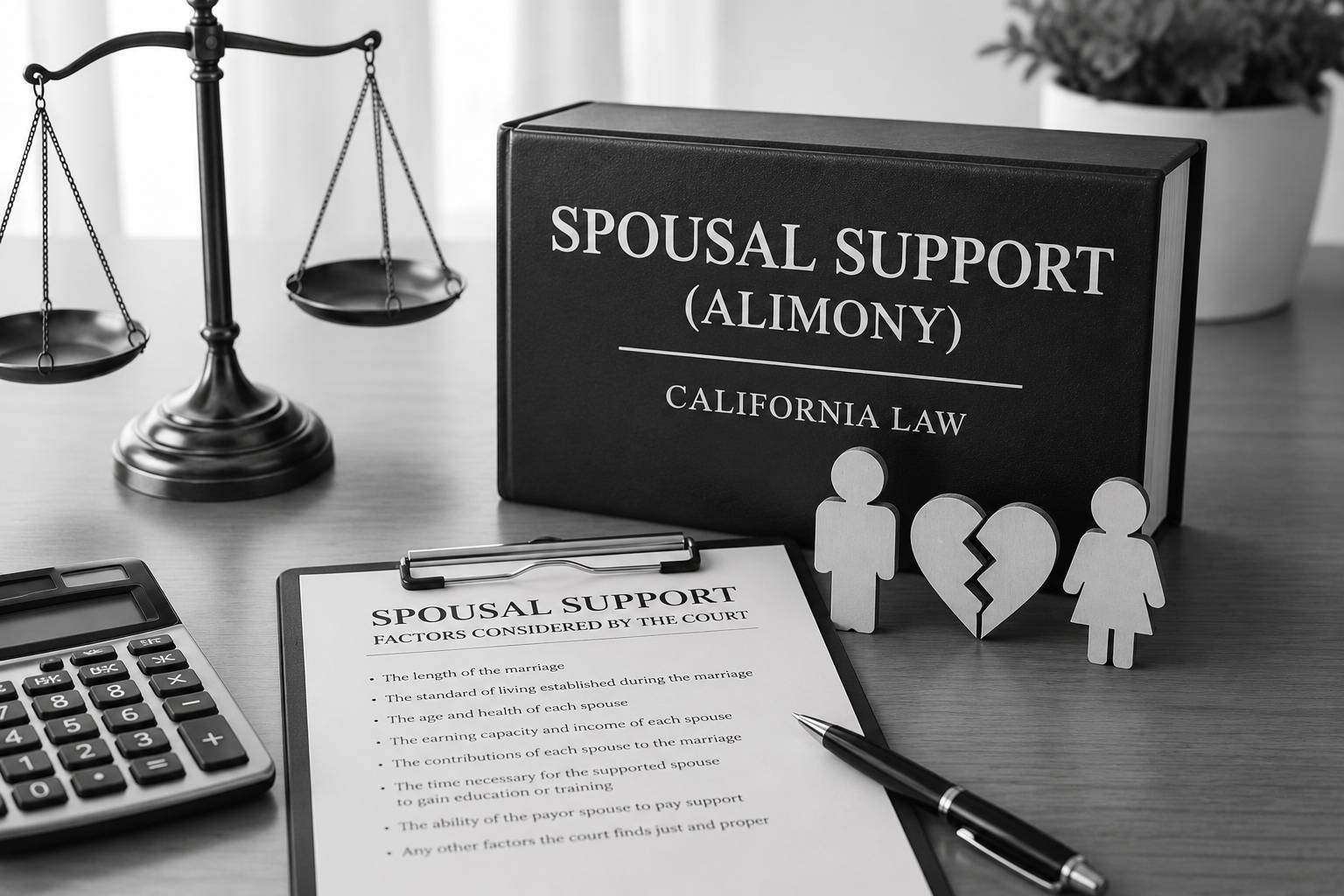
Types of Spousal Support in California
California courts recognize two main types of spousal support: temporary support ordered while the divorce is pending and permanent (post-judgment) support ordered after the divorce is finalized. Understanding the difference between these two types is essential to planning your financial strategy.
Temporary Spousal Support
Temporary spousal support is ordered while the divorce case is still pending in court. It is designed to help the lower-earning spouse cover living expenses during the legal process. California Family Code Section 3600 governs temporary spousal support and gives courts broad discretion in setting the amount.
Most California counties, including Orange County, use computer software (such as Dissomaster or XSpouse) to calculate a guideline amount for temporary support. The calculation is based on each spouse’s gross income and certain deductions, including taxes, health insurance, and retirement contributions. While the guideline amount is not legally mandatory, courts generally follow it absent unusual circumstances.
Permanent Spousal Support (Post-Judgment Support)
Despite its name, permanent spousal support does not necessarily last forever. It refers to the support ordered at the conclusion of the divorce case, setting long-term financial obligations. Permanent spousal support is calculated very differently from temporary support. Courts do not apply the guideline software calculation. Instead, they analyze a comprehensive list of factors under California Family Code Section 4320.
| Feature | Temporary Support | Permanent Support |
|---|---|---|
| When it applies | During divorce proceedings | After the final divorce judgment |
| Calculation method | County guideline software (Dissomaster) | Family Code Section 4320 factors |
| Duration | Until the divorce is finalized | Varies based on marriage length and circumstances |
| Modifiable | Yes, based on changed circumstances | Yes, based on changed circumstances |
| Governing statute | Family Code Section 3600 | Family Code Section 4320 |
How Is Alimony Calculated in California?
Permanent spousal support in California is not determined by a fixed formula. California Family Code Section 4320 requires courts to evaluate a comprehensive list of factors before setting an award. These factors reflect the unique circumstances of the marriage and the financial realities facing both spouses.
Courts must weigh all of the following factors before ordering permanent spousal support:
| Factor Under Family Code Section 4320 | What the Court Considers |
|---|---|
| Length of the marriage | Longer marriages often support longer or higher support obligations |
| Marital standard of living | The lifestyle maintained during the marriage is the primary benchmark |
| Income and earning capacity | Both spouses’ income, job skills, education, and ability to earn |
| Supported spouse’s financial needs | The actual monthly expenses of the spouse requesting support |
| Supporting spouse’s ability to pay | The paying spouse’s current and projected income and obligations |
| Contributions to education or career | Whether one spouse supported the other’s education or career advancement |
| Time out of the workforce | Years spent raising children or managing the household instead of working |
| Age and health | Older spouses or those with serious health conditions may qualify for greater support |
| History of domestic violence | Documented abuse significantly affects the support determination |
| Tax consequences | The court considers the tax impact on both parties under current federal law |
| Balance of hardships | Courts weigh the financial burden imposed on each party by the support order |
| Goal of self-sufficiency | Courts encourage supported spouses to become financially independent |
No single factor controls the outcome. Courts weigh all relevant circumstances together. Our attorneys at Sarieh Family Law have extensive experience analyzing these factors to build the strongest possible argument on your behalf, whether you are seeking support or working to keep a payment amount fair.
Smith/Ostler Orders for Variable Income
If one spouse earns a variable income that includes bonuses, commissions, or overtime pay, the court may issue a Smith/Ostler order. This type of order sets a base monthly support amount plus a percentage of any additional income above the base. Smith/Ostler orders are particularly common in high-asset divorce cases involving executive compensation, sales commissions, or business ownership in Orange County.
- Catching the Warning Signs of Marital Strife Knowing the warning signs of marital strife is key to having a healthy relationship with your spouse. These signs—communication breakdown, no emotional connection, constant criticism—can all mean deeper issues in the marriage. Addressing these signs early can stop the decline and build a more supportive partnership. Another big warning sign is living separate lives, emotional disconnection, and isolation. This can damage the bond between spouses and children, so we need… Read More
- The Social Media Evidence Trap in a Divorce Every day, millions of people share details on social media. In Orange County divorce proceedings, those moments become evidence that can significantly impact your case. According to the American Academy of Matrimonial Lawyers, over 80 percent of divorce attorneys have reported increased use of social media as evidence in divorce cases. A photograph showing you enjoying luxury vacations while claiming financial hardship creates a contradiction that judges notice. Screenshots and… Read More

How Long Does Alimony Last in California?
The duration of spousal support depends heavily on how long the marriage lasted and the judge’s overall assessment of both parties’ circumstances. California courts approach short-term and long-term marriages very differently.
Short-Term Marriages (Under 10 Years)
For marriages lasting fewer than 10 years, courts commonly use a guideline of approximately one-half the length of the marriage as a starting point for support duration. For example, in an eight-year marriage, support might last approximately four years as a general benchmark. However, this is a judicial practice, not a strict statutory requirement. California judges retain full discretion to order a longer or shorter duration based on the unique facts of each case, and either party can petition the court to modify the order if circumstances change significantly.
Long-Term Marriages (10 Years or More)
For marriages lasting 10 years or longer, California Family Code Section 4336 creates a presumption that the court will retain jurisdiction over spousal support indefinitely. This does not mean support continues forever, but the court preserves the authority to review, modify, or terminate the order as circumstances evolve over time. The supported spouse may receive support for a considerably longer period in these cases.
California courts consistently encourage the supported spouse to make reasonable efforts toward becoming self-supporting. In some cases, a judge will issue what is known as a Gavron warning, formally notifying the supported spouse that they are expected to work toward financial independence. Failure to make good-faith efforts toward self-support can result in a reduction or termination of support at a later hearing.
| Marriage Length | General Approach to Support Duration |
|---|---|
| Under 5 years | Guideline of approximately one-half the marriage length; courts have full discretion |
| 5 to under 10 years | Guideline of approximately one-half the marriage length; courts have full discretion |
| 10 years or more | Indefinite court jurisdiction under Family Code Section 4336; duration set by the court |
| Any length with a domestic violence history | Family Code Section 4325 may affect both the support amount and duration |
Modifying or Terminating Spousal Support
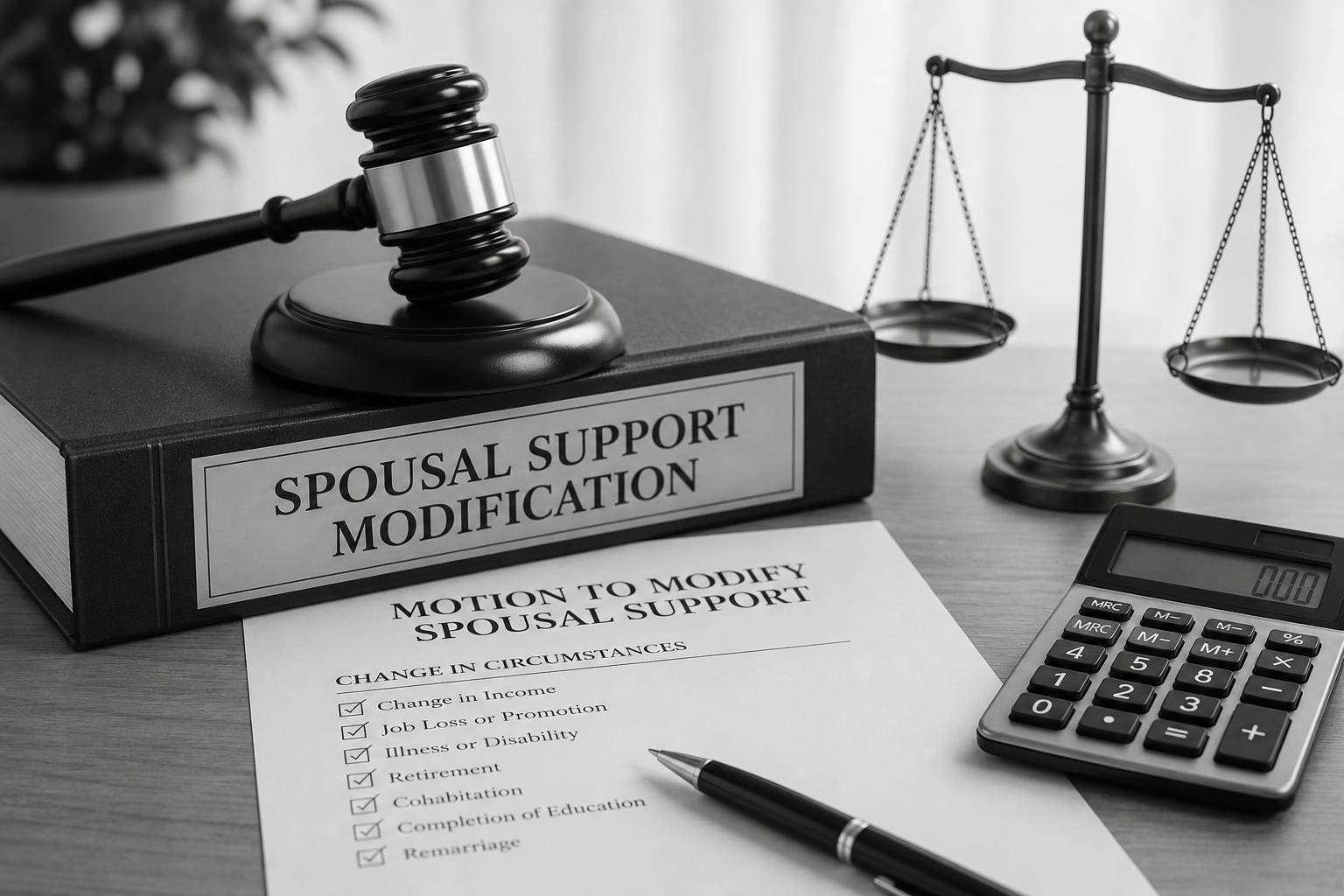
Either spouse can ask the court to modify a spousal support order when there has been a material change of circumstances since the original order was made. California courts do not modify support simply because one party is dissatisfied with the amount. There must be a genuine and significant change that affects the financial picture of either spouse.
Common reasons for seeking a support modification include:
- A significant change in either spouse’s income, such as a job loss, major promotion, or new business
- A serious illness or disability affecting either party’s ability to work
- Retirement of the paying spouse, particularly at or after traditional retirement age
- The supported spouse is beginning to cohabit with a new partner in a romantic relationship
- The supported spouse is completing education or acquiring new skills that increase their earning capacity
- Remarriage of the supported spouse, which terminates support automatically under Family Code Section 4337
To request a modification, you must file a motion with the Orange County Superior Court and present evidence of the changed circumstances. Our firm guides clients through this process and builds compelling cases for both increases and reductions in spousal support.

When Does Spousal Support End in California?
Spousal support does not continue indefinitely in most cases. Under California law, support terminates automatically in certain situations and may be reduced or ended by court order in others.
Spousal support terminates automatically when:
- Either spouse dies
- The supported spouse remarries (Family Code Section 4337)
Spousal support may be reduced or terminated by the court when:
- The end date specified in the divorce judgment or marital settlement agreement arrives
- The supported spouse cohabits with a new romantic partner (see below)
- The supported spouse fails to make reasonable efforts toward self-sufficiency after a Gavron warning
- There is a material change of circumstances that warrants a modification
Cohabitation and Spousal Support
(Family Code Section 4323)
Under California Family Code Section 4323, there is a rebuttable presumption that spousal support should be reduced or terminated when the supported spouse lives with a new partner in a romantic relationship. The law presumes that cohabitation decreases the supported spouse’s need for financial assistance from the paying spouse.
However, this presumption can be challenged with evidence showing that cohabitation does not actually reduce the supported spouse’s financial need. If you believe your former spouse is cohabiting with a new partner and your support obligation should be reduced, our attorneys can help you file the appropriate motion with the court.

Free In-Depth Case Evaluation
Domestic Violence and Spousal Support in California
California law specifically addresses how domestic violence affects spousal support determinations. Under Family Code Section 4325, if a spouse has been convicted of domestic violence against the other spouse within the five years prior to the filing of the divorce petition, there is a rebuttable presumption that the convicted spouse should not receive spousal support.
This provision is designed to protect domestic violence survivors from being placed at a financial disadvantage during the divorce. Courts will still consider the full circumstances of the case, but the convicted party faces a significant legal presumption against receiving support. Our attorneys handle these sensitive cases with the care, discretion, and professionalism they require.
Tax Implications of Alimony Under Current Federal Law
A significant change in federal tax law affects how alimony is treated for divorces finalized on or after January 1, 2019. Under the Tax Cuts and Jobs Act of 2017:
- Alimony payments are no longer tax-deductible for the paying spouse
- Alimony payments are no longer considered taxable income for the receiving spouse
This represents a major departure from the rules that applied to divorces finalized before 2019, under which the payer could deduct alimony and the recipient had to report it as income. For divorces finalized on or before December 31, 2018, the prior tax rules continue to apply unless the agreement is substantially modified after that date.
Understanding these tax implications is an important part of your overall divorce strategy. We recommend working with both a family law attorney and a qualified tax professional when structuring your spousal support arrangement to ensure you fully understand the financial impact of your agreement.
Vocational Evaluations in Spousal Support Cases
Under California Family Code Section 4331, either party can request that the court order a vocational evaluation to assess the supported spouse’s ability to work and their potential earning capacity. A vocational evaluator reviews the supported spouse’s educational background, work history, job skills, and current job market conditions to estimate what that person could realistically earn.
Vocational evaluations are often requested when the supported spouse claims they are unable to become self-supporting, but the paying spouse believes the other party has the capacity to find employment. Courts rely on the evaluator’s findings when determining both the amount and duration of support. If a vocational evaluation has been requested in your case, our attorneys can help you prepare and respond effectively to the evaluator’s conclusions.
Enforcing a Spousal Support Order in Orange County
If your former spouse fails to make court-ordered spousal support payments, California law provides several enforcement options. Unpaid spousal support accrues 10 percent annual interest under California law, so acting quickly is important to prevent arrears from compounding. Our attorneys can help you pursue enforcement through the Orange County Superior Court using tools such as:
- Earnings assignment orders (wage garnishment) that automatically deduct payments from the paying spouse’s paycheck
- Bank account levies to collect funds directly from financial accounts
- Contempt of court proceedings, which can result in fines or incarceration for willful non-payment
- Liens on real property owned by the non-paying spouse
- Coordination with the California Department of Child Support Services when child support and spousal support obligations overlap
Contact our office as soon as payments stop. Timely action protects your rights and maximizes your recovery of past-due support.
How Sarieh Family Law Approaches Spousal Support Cases
At Sarieh Family Law, we represent clients on both sides of spousal support disputes throughout Costa Mesa, Tustin, Irvine, and all of Orange County. Our practice focuses exclusively on family law, which allows us to bring a deep and current understanding of California’s spousal support statutes and case law to every client matter.
Attorney Wail Sarieh has spent more than 20 years representing California families through complex divorce and family law proceedings. His approach is thorough and client-centered. When you work with Sarieh Family Law, you can expect:
- A careful analysis of your financial picture and your spouse’s income and assets
- Clear identification of every applicable factor under Family Code Section 4320
- Coordination with financial professionals, including forensic accountants and vocational evaluators, when necessary
- Skilled negotiation aimed at reaching a fair resolution without unnecessary litigation
- Vigorous advocacy in the Orange County Superior Court if a settlement cannot be reached
We understand that spousal support disputes can be among the most emotionally and financially stressful aspects of a divorce. Our team is committed to giving you honest, direct guidance and working toward an outcome that positions you for long-term stability.
Sarieh Family Law is also deeply committed to the Orange County community. We believe that strong families are the foundation of strong communities, and we work hard to give back through education and youth development initiatives throughout Southern California.
Contact Our Orange County Alimony Attorneys Today
If you are facing a spousal support issue in Costa Mesa, Tustin, Irvine, or anywhere in Orange County, the family law team at Sarieh Family Law is ready to help. We will review your situation, explain your rights under California law, and develop a strategy tailored to your financial goals and circumstances.
Call us to schedule your consultation or reach out through our website. Our team is here to help you move forward with clarity, confidence, and the legal protection you deserve.
This content is for informational purposes only and does not constitute legal advice. The outcome of any legal matter depends on its specific facts and circumstances. Past results do not guarantee future outcomes. Contact Sarieh Family Law for legal advice specific to your situation.

Recent Case Results
-
Our client in this case was the mother of the only child of marriage. Our child custody law firm took the case that started in 2009 with the mother filing a Petition for custody and support of a child against the father where the parties reached a stipulation and order awarding the mother sole legal and sole physical custody. Later on the mother filed a divorce case and since the father failed to respond, the mother entered his default in 2010. The divorce case was consolidated with the paternity case.
In early 2012, the mother and without notifying the father moved to another State. The father filed a police report and hired a very aggressive Orange County Family Law attorney who filed an emergency motion with the court (ex parte application) and obtained custody for the father and appointed a child custody investigator.
The mother was arrested on a DUI despite the fact that her car was parked and she was not driving; the police justified the DUI charge as they found an open container in the car.
The child custody investigation report, based on the mother’s DUI conviction and the fact that she moved away without notifying the father, came to the conclusion that the mother should only have supervised visitation with the child and that father should have sole legal and sole physical custody of the minor child.
The matter was further complicated by the mother agreeing to “bifurcate” the trial on the custody and visitation issues and the trial was set for the second half of 2013.
The mother decided to retain Sarieh Family Law to help her litigate the child custody during the bifurcated trial.
Mr. Sarieh, an Orange County Certified Family Law Specialist challenged the entire proceedings from 2010 to 2013. Mr. Sarieh argued that every document filed including but not limited to the child investigation report and every court order rendered after the entry of default in 2010 is null and void.
Our firm was very proud of the results and very proud of our judicial officers. The judge agreed with Mr. Sarieh that the court has no jurisdiction since the default was entered in 2010. The trial by default was set in month and our client obtained a dissolution judgment awarding her sole legal and sole physical custody of the minor child.
-
Our client in this case was the father of two children; the parties were not married but cohabited together for over a decade. Throughout their cohabitation both parties worked hard to support their children; the parties lived in an upper-middle class life style during their cohabitation. Shortly after their separation, the mother claimed disability due to Reactive Airway Disease (RAD) she quit her job as mortgage broker, collected State Disability checks and filed Worker’s Compensation claim alleging her disability resulted from the poor air quality at her office.
Mr. Sarieh, an Orange County Certified Family Law Attorney, filed with the court a request to vocationally evaluate the mother. Unfortunately the vocational evaluation report concluded that the mother is employable but her employability depended on her health condition, which was beyond the vocational evaluator expertise.
In a trial that spanned over the period of months, Mr. Sarieh was able to successfully cross-examine Petitioner’s primary care physician who came to testify on her behalf. The physician admitted that his patient; the mother is able to work under certain conditions.
Mr. Sarieh subpoenaed all medical reports from the Worker’s Compensation case and was able to establish the mother’s ability to work. The Court agreed with Mr. Sarieh and stated that the mother has the obligation to support the children; the court imputed income to the mother and the child support was calculated according to the mother’s imputed income even though she was still not working at the time of trial.
-
Our client in this case was the husband, who with the wife’s agreement entered into a stipulated judgment awarding the family residence to the wife; neither party was represented and they entered the judgment with the assistance of a paralegal in Orange County. The parties were married for long time and have adult children from their marriage.
The untold story was despite the written judgment; the parties had verbally agreed that once the house is sold the wife will give the husband his fair share of the proceeds.
Of course, wife sold the house and refused to pay husband any monies. The husband sought the assistance of Sarieh Family Law; Orange County Divorce attorneys.
We began our investigation by examining the judgment, which stated unequivocally that wife gets the house. We were also faced with the legal hurdle that it is almost impossible to set aside a judgment in California if the judgment only dealt with property division and without fraud, duress or undue influence.
We noticed on the Resister of Action on the Court’s website that the initial submission of judgment was rejected by the court and that the judgment was returned. The judgment was re-submitted again and the court accepted it. We asked our client whether he knew anything about the rejection of the judgment and he indicated that he knew nothing about this rejection.
We asked for a copy of the entire file from the court itself and we did not rely only on what our client gave us. We set the wife’s deposition at our office.
We received the ordered copy of the court’s file on the morning of the wife’s scheduled deposition at our office. After a careful examination of the court’s file with our client, we found out the signature on our client’s Declaration re: Service of Declaration of Disclosure was not his.
We confronted the wife during her deposition about the falsified document but she denied any involvement and blamed the paralegal. She acknowledged that the document was not signed by our client.
We subpoenaed the paralegal to the court’s hearing to prove the wife’s fraud and we retained a handwriting expert to prove that our client’s signature was falsified by the wife herself and no one else.
Right before we entered the court room to try our case, the wife’s attorney approached us with a settlement offer giving our client what he was promised. Our client accepted the offer for the sake of the parties’ adult children.